
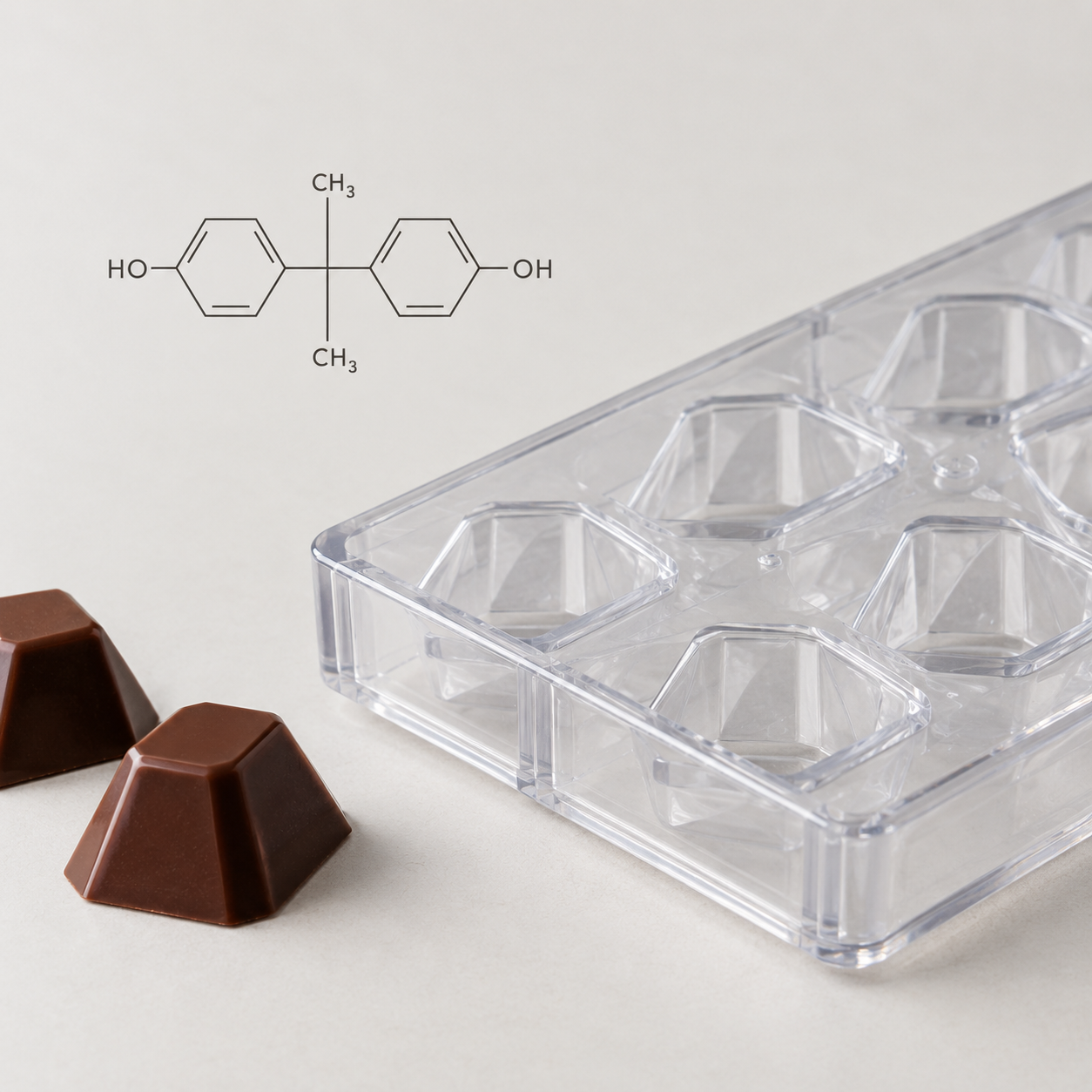
Bisphenol A, often shortened to BPA, comes up in every discussion about food contact materials. In chocolate making, it directly concerns an everyday tool: the polycarbonate mould. What is bisphenol A, what do European rules say and are your moulds affected? Here are the essentials, followed by the solutions for producing without BPA.
What is bisphenol A?
Bisphenol A (BPA) is a synthetic chemical substance. It is mainly used as a starting substance to manufacture two families of materials: polycarbonate plastics and epoxy resins. It was therefore found in can coatings, jar lids, reusable bottles and food production equipment.
BPA belongs to a wider family, the bisphenols, which includes other substances such as bisphenol S (BPS). This is why European regulation now targets BPA as well as other bisphenols.
Why is polycarbonate affected in chocolate making?
Polycarbonate is made from bisphenol A. It is also the most widely used material for professional chocolate moulds, thanks to its rigidity and the shine it gives to pralines and bars. As a result, every chocolatier working with polycarbonate is affected by the changing rules. For demoulding and shine, see also our comparison polycarbonate or silicone chocolate moulds.
What does Regulation (EU) 2024/3190 say?
Regulation (EU) 2024/3190 of 19 December 2024, in force since 20 January 2025, restricts the use of bisphenol A, other bisphenols and their derivatives in materials that come into contact with food.
According to the analysis published by the Food Packaging Forum, most food contact articles made with BPA can no longer be placed on the EU market since 20 July 2026. However, a longer transition, until 20 January 2028 for placing on the market, applies to certain reusable professional food production equipment.
Key point: the timetable depends on the category of your mould. Ask your supplier to confirm the exact status of each reference.
How do you know whether your moulds are affected?
The simplest way is to ask your supplier. Then check three documents:
- The declaration of compliance with Regulation (EC) No 1935/2004 for each mould.
- The composition of the material: polycarbonate, copolyester or silicone.
- The “BPA free” statement, backed by migration test results.
For the full approach to equipment, read our article on HACCP compliance of equipment.
Need a BPA free chocolate mould?
What are the solutions for producing chocolate without BPA?
Two families of moulds let you work without bisphenol A: rigid moulds made from Ecozen, the bio-based equivalent of BPA-free polycarbonate and food grade silicone moulds. We explain how to choose between them in our guide how to choose a BPA free chocolate mould.
At Maé, our Silmaé moulds are made in France from a food grade silicone formulated without BPA.
BPA free
Silicone formulated without BPA, BPS or phthalates.
Tested
Migration tests to FDA, LFGB and CE standards.
-40 °C to +280 °C
From depositing to freezing.
Made in France
Compatible with automated lines.
Pralines and small pieces
Silicone confectionery moulds with many cavities per sheet.
Frequently asked questions
Switch to BPA free chocolate moulds
Tell us your products and volumes: we will suggest the right mould and send you a sample.


