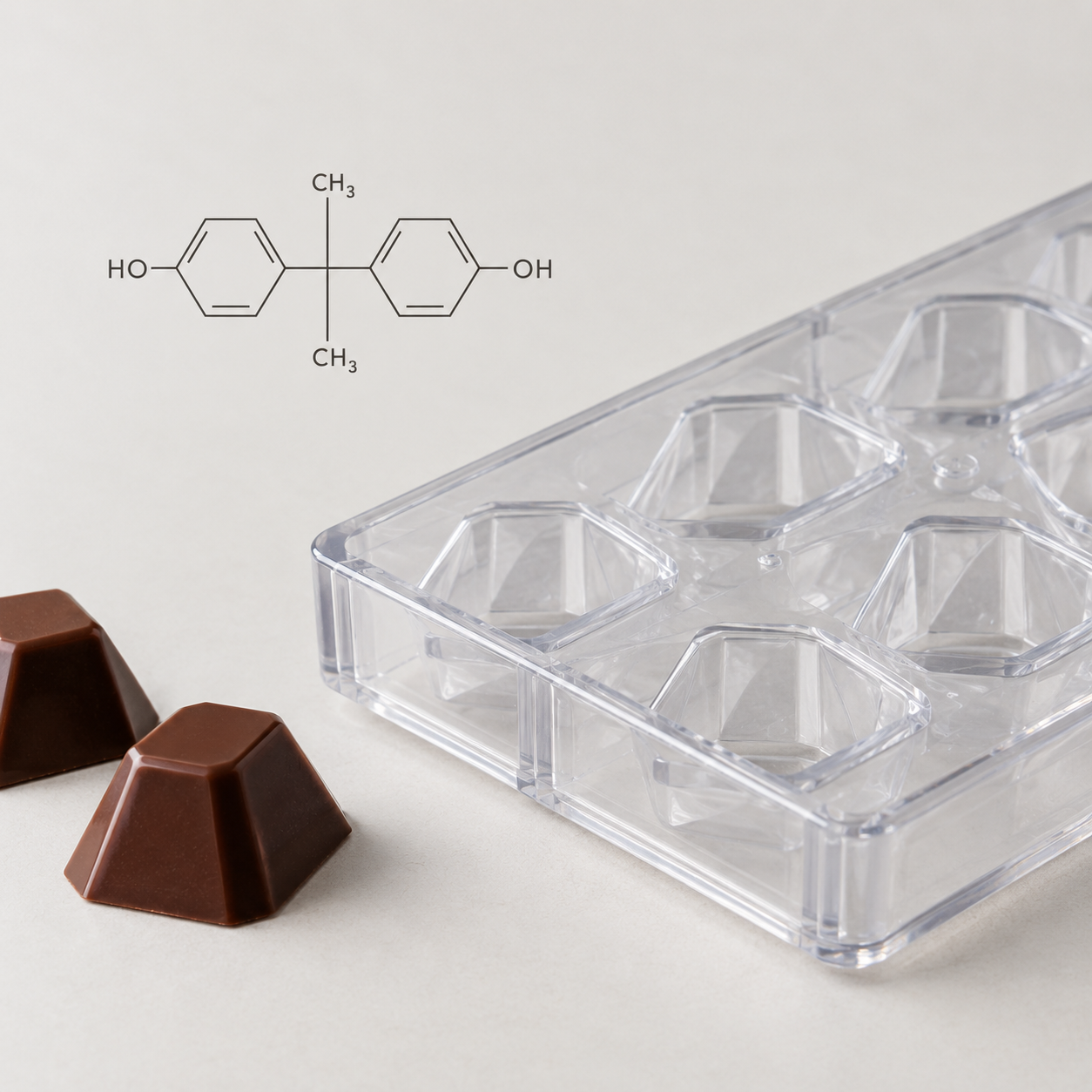
Choosing a chocolate bar mould is never just a question of shape. In fact, it sets your bar weight, your output rate and, ultimately, your cost per bar. With cocoa prices under pressure, every single gram counts. This guide walks you through choosing the right mould format for profitable production, from bar weight to material, right through to working out your true cost per bar.
Why the chocolate bar is your number one entry product
The bar is the product that brings a customer into your world for the first time. Indeed, it is the entry product par excellence: affordable, easy to give as a gift and simple to extend into a full range. As a result, it often carries a disproportionate share of turnover for its shelf space, because it sells on impulse rather than on occasion.
Moreover, the bar has a decisive advantage over a box of filled chocolates: it is quick to produce, it needs very little labour and it relies on a single mould. Therefore, its controlled production cost makes it a genuine margin lever, provided you choose the right format. In practice, a signature bar also becomes a marker of identity, whereas an assortment spreads your production effort thin.
What bar weight should your chocolate bar mould produce?
Bar weight is the first decision to make. Indeed, it drives your retail price, your positioning and your margin all at once. Here are the three reference formats.
100 g: the standard that reassures the customer
The 100 g format is the historic benchmark for a chocolate bar. Above all, it is the shopper’s reference point: they know roughly what it should cost and they compare easily. Therefore, the 100 g bar reassures and makes impulse buying straightforward. As a result, it remains essential in any range, even though its margin tightens whenever cocoa climbs.
70 g to 80 g: the format that protects margin when cocoa rises
Faced with rising cocoa costs, many makers have moved from 100 g to 80 g in order to protect their margin without unsettling customers on the shelf price. This discreet reduction in bar weight is a long established strategy in the sector. Therefore, the 70 g to 80 g format keeps an attractive price point while protecting profitability. Moreover, it suits premium tasting bars particularly well, where intensity matters more than quantity.
Mini bars and snack bars: till point, gift box and corporate orders
Mini bars and snack bars open up entirely different uses. For example, they work at the till point for impulse purchases, inside tasting boxes and across personalised corporate orders. As a result, these smaller formats lift your average basket and let you add value to offcuts or end of run chocolate. In practice, they broaden your range without making production any more complex.
| Bar weight | Margin logic | Occasion | Positioning |
|---|---|---|---|
| 100 g | Familiar price point, margin squeezed when cocoa rises | Everyday purchase, simple gift | Entry product, customer benchmark |
| 70 g to 80 g | Shelf price held, margin protected | Tasting bars, single origin | Premium, protects margin |
| Mini bars and snack bars | Low ticket price, sold by the unit | Till point, gift box, corporate | Average basket, personalisation |
Retail pricing varies widely by market, positioning and cocoa origin. The number of cavities per sheet depends on the mould model and its size.
Polycarbonate or silicone chocolate moulds: which one for which production?
The material of your chocolate bar mould determines both the finish and how easily the bar comes out. Indeed, each material follows its own logic.
Polycarbonate: gloss, snap and sharp edges
Polycarbonate is the reference for a classic bar. It delivers maximum gloss, a clean snap and sharp, well defined edges. Therefore, it showcases careful tempering and a premium finish. As a result, it is the natural choice for tasting bars, where appearance matters as much as flavour.
Silicone: flexibility, complex shapes, risk free demoulding
Silicone brings a flexibility that changes how you produce. In particular, it makes demoulding easy on complex shapes and detailed relief, with no risk of breakage. Therefore, it is ideal for patterned bars, bespoke creations and generous inclusions. Moreover, that flexibility secures demoulding, which is a real advantage once you are running at volume.
The deciding factor: gloss or shape?
The choice usually comes down to one simple question. If you are after maximum gloss and the perfect snap of a classic bar, polycarbonate wins. By contrast, if complex shapes, relief or bespoke designs come first, silicone is the right call. That is precisely the speciality of Maé Innovation, a silicone mould specialist since 1994. To go deeper into this comparison, read our guide to the professional chocolate mould.
Output: how many bars per hour with which mould?
Your output rate depends on three factors. First, the number of cavities per sheet: the higher it is, the more bars you cast in a single operation. Then comes the tempering bottleneck, because your tempering machine has to keep pace with your casting. Finally, mould rotation matters, since holding several sets lets you cast while others are still crystallising.
In practice, tempering is very often the limiting factor rather than the mould itself. Badly tempered chocolate slows the whole station down and wastes production. Therefore, optimising output means matching your tempering throughput to your number of cavities. To master this key stage, read our guide to tempering chocolate.
Inclusion bars, filled bars and the Dubai chocolate bar
Beyond the plain bar, filled versions are where real value is created. Inclusion bars, with nuts, cocoa nibs or cereals, are made by scattering the pieces before or during casting. Therefore, they enrich your range without changing the mould at all.
A filled bar, by contrast, relies on double casting: a first layer of chocolate forms the shell, the filling is deposited, then a second layer seals the bar. In practice, that is exactly the technique behind the Dubai chocolate bar, the viral creation built from a chocolate shell, a pistachio cream centre and crisp kadayif pastry. Moreover, this kind of generous bar calls for a deep mould and careful demoulding, which makes the choice of mould decisive. These flavour pairings also connect closely with our article on combining chocolate and fruit.
What does a finished bar really cost to produce?
The true cost of a bar goes well beyond the price of the chocolate. In fact, it adds up three items: materials, meaning chocolate, filling and packaging; labour, covering tempering, casting, demoulding and packing; and the amortisation of the mould spread across its working life. Therefore, a durable mould costs more to buy, yet less per bar produced over the long run.
In practice, the sharp rise in cocoa has weighed heavily on the materials line, which is exactly why so many makers have shifted to an 80 g format. As a result, calculating your break even point per bar becomes essential before you set your price. To take this further, read our guide to calculating your cost price.
Our Maé Innovation chocolate bar moulds
To answer these format and profitability challenges, Maé Innovation designs silicone moulds and mats dedicated to the chocolate bar. Our silicone bar mat with raised edges lets you cast bars to a consistent format, with easy demoulding and an even thickness throughout. Therefore, the flexibility of Silmaé platinum silicone secures demoulding, even on relief work and bespoke creations made in France.
Moreover, Silmaé silicone is manufactured in France from premium, food contact grade silicone, suitable for both deep freezing and baking. As a result, these moulds and mats suit the individual chocolatier just as well as a growing chocolate manufacturer scaling up output. For very fine work chasing maximum gloss, the Maé bespoke service adapts to your own specification.
- Silicone bar mat with raised edges: even thickness, easy demoulding
- Silmaé platinum silicone: complex shapes, relief, bespoke designs
- Food contact grade, suitable for deep freezing and baking
- Made in France, standard or bespoke
Make your chocolate bars more profitable
Maé Innovation manufactures Silmaé silicone bar moulds and mats in France, for every bar weight. From the standard format through to your own signature design.